Using .Where()
You Will Learn:
How
Where()filters data at different levels of a queryHow the position of
Where()relative toSelect()changes the resultHow to skim events using
Where()at the event level
As discussed on the query structure page, the location of the Where() function determines the level in the data at which the cut applies. The examples on this page build a strong understanding of using Where() in xAOD queries.
Applying pt Cuts
A Where() call can apply a pt cut at multiple positions in a query, and the position changes the resulting data. The difference comes from the location of Where() relative to the Select() functions. The two examples below illustrate this difference.
Apply to All Values
The following code applies the pt cut before any values are selected from the jets. As a result, pt, eta, and phi all come only from jets with 30 GeV or higher.
query = FuncADLQueryPHYSLITE()
jets_per_event = (query
    .Select(lambda e: e.Jets().Where(lambda j: (j.pt() / 1000 > 30)))
    .Select(lambda jets: {
        'pt': jets.Select(lambda j: j.pt() / 1000),
        'eta': jets.Select(lambda j: j.eta()),
        'phi': jets.Select(lambda j: j.phi()),
    })
)
Apply only to pt Values
The following code applies the pt cut only before the pt Select() operator. As a result, only the pt values come from cut jets, while eta and phi come from all jets.
query = FuncADLQueryPHYSLITE()
jets_per_event = (query
    .Select(lambda e: e.Jets())
    .Select(lambda jets: {
            'pt': jets.Where(lambda j: (j.pt() / 1000 > 30)).Select(lambda j: j.pt() / 1000),
            'eta': jets.Select(lambda j: j.eta()),
            'phi': jets.Select(lambda j: j.phi()),
    })
)
Comparison
Plotting the Jet pt and Jet eta demonstrates the difference between these methods.
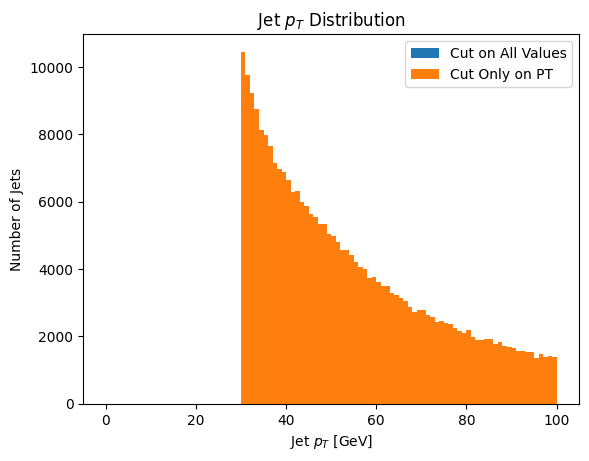
The plot above shows that the Jet pt data is identical between both methods of applying the cut, as expected.
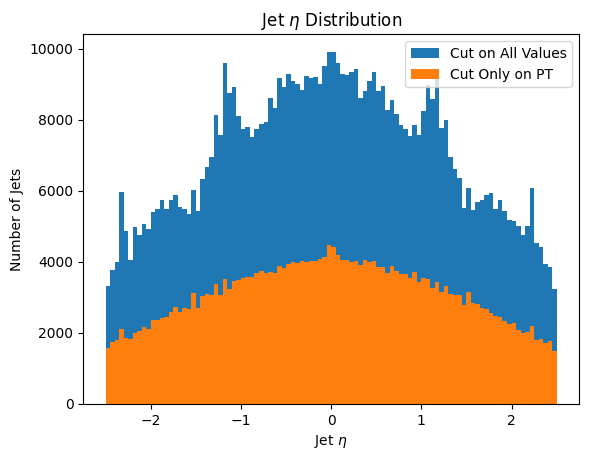
The eta plot above shows that the Jet eta values differ between the two methods. The eta values are not trimmed when Where() is not called before the eta Select().
Skimming Events
Skimming events requires using Where() at the event level of the query, which takes place before the first Select(). The example below builds a query that selects jets with pt > 30 GeV from events containing at least one jet of 100 GeV.
query = FuncADLQueryPHYSLITE()
jets_per_event = (query
    .Where(lambda e: e.Jets().Where(lambda j: (j.pt() / 1000 > 100)).Count() > 0)
    .Select(lambda e: e.Jets())
    .Select(lambda jets: {
            'pt': jets.Where(lambda j: j.pt() / 1000 > 30).Select(lambda j: j.pt() / 1000),
    })
)
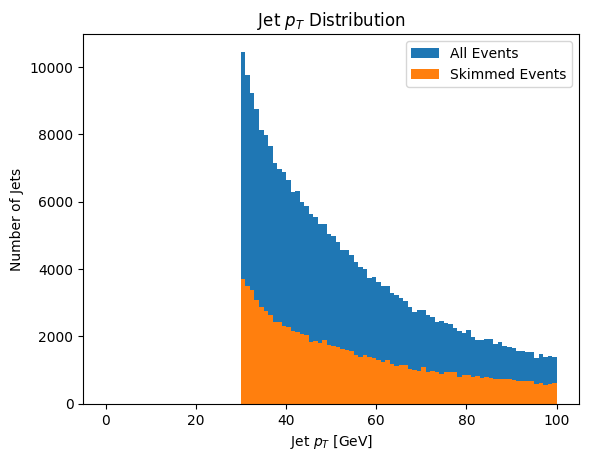
Comparing the results to the first set of examples shows far fewer jets, which is expected when looking at fewer events.